
orangu
orangu is a terminal-based, locally-hosted AI coding environment - and a complete, self-contained AI coding stack, not just a client. It ships the coding environment, the model coordinator, and a native GGUF inference server, written end to end in Rust , so every line of your code stays on your own machine.
With zero telemetry and no cloud uploads, orangu is built for developers in regulated or air-gapped environments - and eliminates the per-token costs of cloud-based assistants by running your own self-hosted models. After orangu-server and your models are downloaded, no Internet connection is required.
It is named after the Orangutan - the smartest ape.
A complete stack from one vendor
Most local AI setups are a patchwork: one tool for the editor, a separate engine for inference, and glue to manage which model is loaded. orangu is the whole stack in one project - three cooperating programs, one language, one license, one installer:
orangu- the workspace-aware coding environment you drive: the terminal interface, local and Git/forge tools,/reviewand/auto_review, the knowledge graph, semantic/search, and the context-compression engineorangu-coordinator- an optional companion HTTP proxy that starts and stops the server on demand and swaps to whichever model each request needs, so a single-GPU machine can use a different model per role without ever running more than one serverorangu-server- the inference engine itself: GGUF loading, tokenization, the transformer forward pass, sampling, and request scheduling implemented directly in Rust, with no llama.cpp, no ggml, and no Python - plus the model inventory and the web console, from the same binary
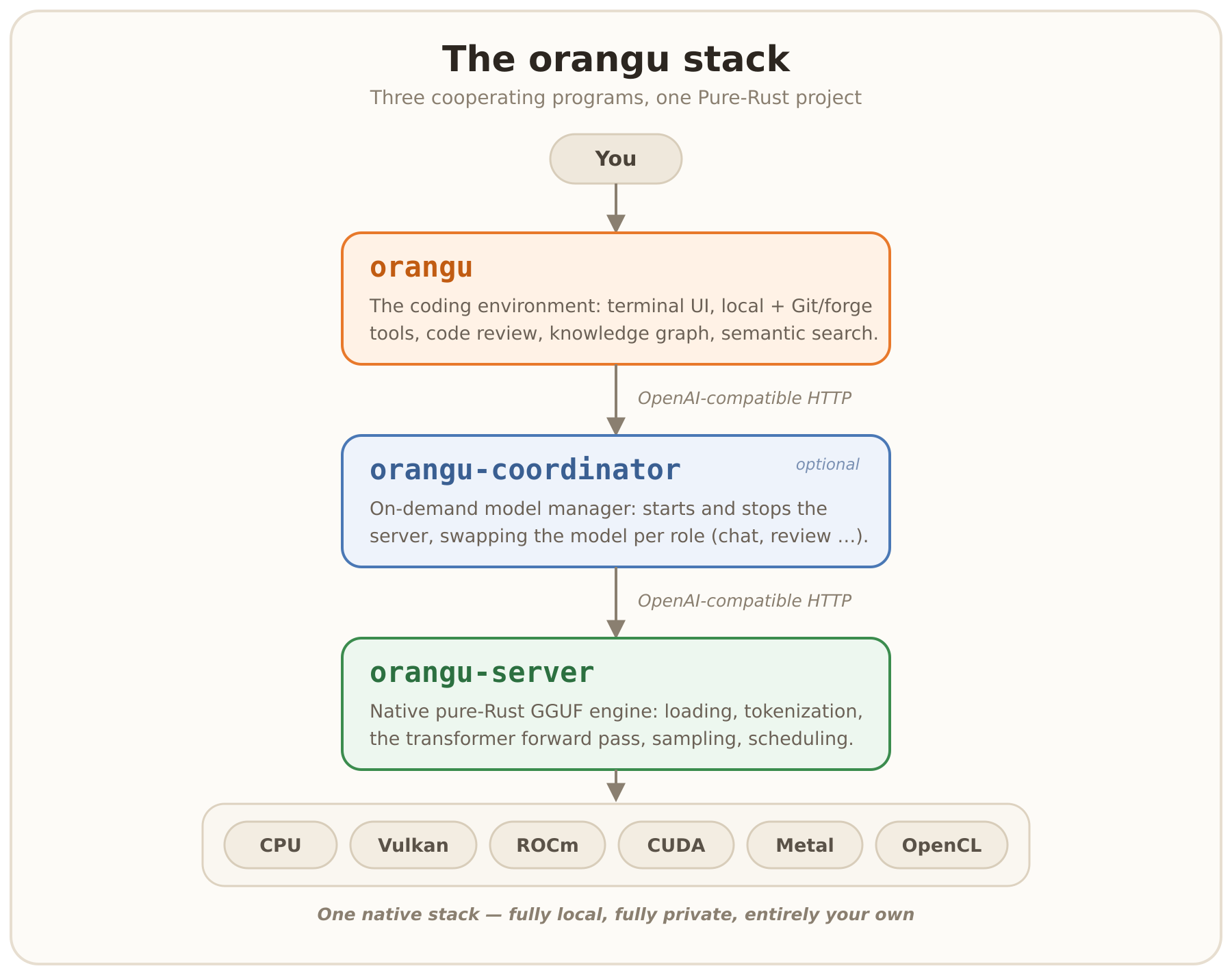
Every layer speaks the OpenAI-compatible API, so the pieces stay cleanly separated - yet they build, ship, install, and run as one.
A fourth binary, orangu-gguf, builds the model files the server runs: it pretrains a model from scratch out of a JSON manifest of permissively-licensed repositories - cloning, tokenizer, corpus packing, training, and GGUF export in one binary - and rewrites an existing model at a smaller weight format. With that, the stack covers the whole path from source repositories to a served model without leaving the project.
Key Features
- Complete privacy - Your code stays on your machine; zero telemetry, no cloud uploads
- Built-in code review - Interactive (
/review) and automated LLM-driven (/auto_review) review with category-based findings and confidence scoring to filter out false positives - Train your own model -
orangu-ggufpretrains a GGUF model from random weights out of a manifest of permissively-licensed repositories, with no Python and no training framework, and quantizes existing models down toQ2_K - Native inference server -
orangu-serverruns GGUF models on CPU, GPU (Vulkan, Metal, CUDA, ROCm, OpenCL), or NPU with continuous batching, prefix caching, KV caching, and an OpenAI-compatible API, and doubles as the machine’s model inventory - Runs the big models - Support for the large model families - DeepSeek 4, GLM 5.3, Kimi K3, Muse-Glimmer, Inkling-Small, Ling, NVIDIA Nemotron, Ornith 1.5, and Qwen 3.8 - with multi-card support so a large model can be spread across the GPUs you already have, and multi-token-prediction draft heads attached automatically for the models that ship them
- Workflow language - Describe multi-step, multi-project jobs in YAML over the same slash commands you drive by hand, including a code-and-review loop that runs until the goal is verified, all validated up front with
--dry-run - NPU support - Rockchip RKNPU matmul offload on boards like the RK3588, alongside detection and reporting for Arm China’s Zhouyi AIPU
- MCP support - Connect external tools over the Model Context Protocol, with local MCP server management, refresh, and reconnect handled inside orangu
- Built-in web console - A browser chat UI served from the same binary, with markdown and syntax highlighting, LaTeX, Mermaid and PlantUML diagrams, live tokens/second, model management, benchmarking with
orangu-bench, and persistent history you can prune - no build step, no external assets - Git-centric workflow - Full Git plus GitHub and GitLab support, driven straight from the prompt, with natural-language aliases for nearly every command
- Workspace-aware tools - Read, edit, list, search, and fetch files and run shell commands, with project and git context
- Builds your project -
/builddetects the toolchain (Cargo, CMake, Autotools, Meson, Maven, Python, Go, plainmake) and runs format, lint, build, and test as one reported pipeline - Knowledge graph & visualization - Tree-sitter powered dependency graph of every function, class, and call, with an interactive HTML visualization (
/graph) - Semantic code search - Find code by meaning, not just text, using offline embeddings (
/search) - Code duplication report - Detect duplicate code across 20+ languages using AST similarity scoring (
/duplicates) - Agent skills & memory - Discovers reusable skills and merges persistent
AGENTS.mdinstructions and memory across sessions - Developer and Committer mode -
/developerand/committershape orangu’s behaviour around what you are doing right now: writing the change, or getting it committed - License header support - Keeps license headers consistent across a codebase as you work in it
- Multi-workspace support - Open multiple projects as tabs in a single instance
- Scriptable and schedulable - Run a single prompt or command and exit (
-p), and let the built-in cron-style scheduler run jobs unattended - Single native binary - Written in Rust for fast startup with no runtime dependencies
- Offline documentation - Complete embedded manual with full-text search
- Advanced context compression - AST-aware file downsampling, intelligent Git diffs, and secret redaction to protect the LLM’s context window
Code review
Code review is orangu’s standout feature, and it runs entirely on your own hardware. Both reviewers work on the changes on your current branch - committed work plus what is still in the working tree - measured against the merge base with the default branch.
/review- a full-screen, two-pane view with the file checklist on the right and the selected file’s diff on the left. Approve or reject each file, comment on any diff line under a chosen category (Overall, Code, Security, Memory, Performance, Test Suite, Documentation), ask the model about the selected file on demand, and open any file in your$EDITORwithout leaving the view/auto_review- the model reviews the whole change and each file on its own, sorts findings into the same seven categories, and ends with anorangu approves/rejects this patchverdict. Per-file depth cycles Normal → Deep → Ignore, and a rigorous rubric combined with confidence scoring (0-100) filters out false positives and pedantic nitpicks, so only high-confidence findings are flagged/create_patch- turns the findings of the last/reviewor/auto_reviewinto changes in the working tree: the model verifies each finding against the current code, implements the valid fixes, updates tests, runs focused validation, and reports what it left alone. It never commits or pushes. The same command resolves and stages the conflicts a stopped merge, rebase, or cherry-pick leaves behind- Share the result -
/export reviewwrites a PDF to the workspace root, and/comment 42 with auto reviewposts the report onto a GitHub or GitLab issue or pull request. Noghorglabneeded
Use Cases
- Privacy-first development - Your code never leaves your workspace
- Air-gapped and regulated environments - A tightly integrated review workflow with no code sent to the cloud
- Cost control - No per-token cloud fees; run the models you already host
- One supplier for the whole stack - Environment, coordinator, and inference engine from a single project, with no integration to own yourself
- Repository-aware coding - Tools understand your project structure and git history
- Codebase exploration - Navigate unfamiliar code with the knowledge graph and semantic search
- Unattended, repeatable work - Describe a job once in a workflow file and run it across every project that needs it, with a code-and-review loop that keeps going until the goal is verified
- A model of your own - Train a small, domain-specific model from permissively-licensed sources with
orangu-gguf, and serve the result from the same stack - Offline development - No internet connection required after initial setup
Installation
The one-liner installer puts the whole stack - orangu, orangu-coordinator, and orangu-server - on the machine in a single step, on Linux, macOS, and Windows:
curl -fsSL https://mnemosyne-systems.github.io/orangu/install.sh | sh
Latest release
orangu 1.3.0 is out - orangu-gguf trains your own model from scratch and quantizes the ones you have, the new workflow language scripts multi-step jobs across several projects, and the NPU joins the list of backends. This release also adds /create_patch, which turns a review into working-tree changes and resolves merge conflicts, along with support for Qwen 3.8-Flash-Next, GLM 5.3, and Ornith 1.5.
Web site
Documentation
- Getting Started Guide
- Manual
- Configuration
- Inference server
- Coordinator
- Workflows
- Building a model
- Releases and Downloads